
MEDANG
INTRODUCTION
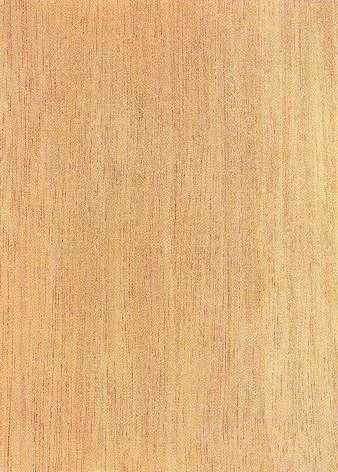
The Standard Malaysian Name for the lightweight members of the family Lauraceae. Vernacular names applied are usually medang (Peninsular Malaysia, Sabah and Sarawak) with various epithets and other localised names too numerous to list here. Major species include Actinodaphne sesquipedalis, A. sphaerocarpa; Alseodaphne insignis, A. nigrescens, A. peduncularis, A. pendulifolia; Beilschemiedia insignis; Cinnamomum sintoc, C. iners, C. javanicum, C. porrectum, C. scortechinii; Cryptocarya bracteolata, C. griffithiana, C. kurzii; Dehaasia cuneata, D. pauciflora, D. polyneura; Lindera bibracteata, L. lucida, L. oxyphylla; Litsea castanea, L. costalis, L. curtisii, L. elliptica, L. firma, L. grandis, L. nidularis, L. robusta, L. tomentosa; Nothaphoebe coriaceae, N. obovata, N. panduriformis, N. umbelliflora; Persea declinata, P. excelsa, P. rimosa; Phoebe declinata, P. elliptica and P. grandis. The sapwood ranges from a light straw-colour to light yellow-green and is not distinct in some species but moderately sharply defined from the heartwood in other species. The heartwood is variable in colour, the majority being light olive-brown to dark green-brown, while some Cryptocarya spp. and Phoebe spp. are light red-brown and some Cinnamomum spp. are pink to light red. Beilschmiedia spp. are yellow-white in colour and Actinodaphne spp. are light yellow-green to dark olive-green.
Also known as Bolly silkwood, Bollywood, Brown walnut, Pepperwood, Rose maple, Silver sycamore and Yellow walnut (Australia); Medang (Brunei); Malo-malo (Fiji); Bonsum, Cinnamon, Kalasum and Nelthare (India); Anjoer poeteh, Bambalinas, Garete borong, Haru, Huru, Kalandoi, Karematoe mongkoeni, Koeni dewata, Kondomge molaba, Lamau-lamau, Latuk, Malika, Medang air, Medang huarau, Medang kelama, Medang lesa, Medang perawas, Medang seluang, Medang tanahan, Medang tariduk, Nio, Ponto lapi, Tabuloh, Tenggera, Woelende and Wuru (Indonesia); Chik dong, Chuang, Mai chouang hom, Mai chuang and Si khaiton (Laos); Kyese, Kyese-payon, Ondon and Shawdu (Myanmar); Tawa (New Zealand); Cryptocarya and Litsea (Papua New Guinea); Bagaoring, Bati kuling, Benogan, Dugkatan, Kaburo, Lamot, Malabunga, Malakadios, Manayan, Marang and Margapali (Philippines); Ranai (Sri Lanka); Kra Thang, Rarechor, Satit, Si-Rai, Thammang, Thang and Thang-baiya (Thailand); and Boi loi (Vietnam).
DENSITY
The timber is a Light Hardwood with a density of 350-880 kg/m3 air dry.
NATURAL DURABILITY
The timber is on the whole non-durable, being subject to fungal attacks. Some species are immune to termite attacks.
PRESERVATIVE TREATMENT
The heartwood is difficult to treat while the sapwood absorbs preservatives readily.
TEXTURE
Texture is moderately fine and even with straight or slightly to moderately interlocked grain.
STRENGTH PROPERTIES
The timber falls into Strength Group C (Engku, 1988b) or SG 6 (MS 544:Part 2:2001).
MACHINING PROPERTIES
It is easy to slightly difficult to resaw and is easy to moderately easy to cross-cut. The timber is easy to plane and the surface produced is smooth to moderately smooth.
NAILING PROPERTY
The nailing property is rated as excellent.
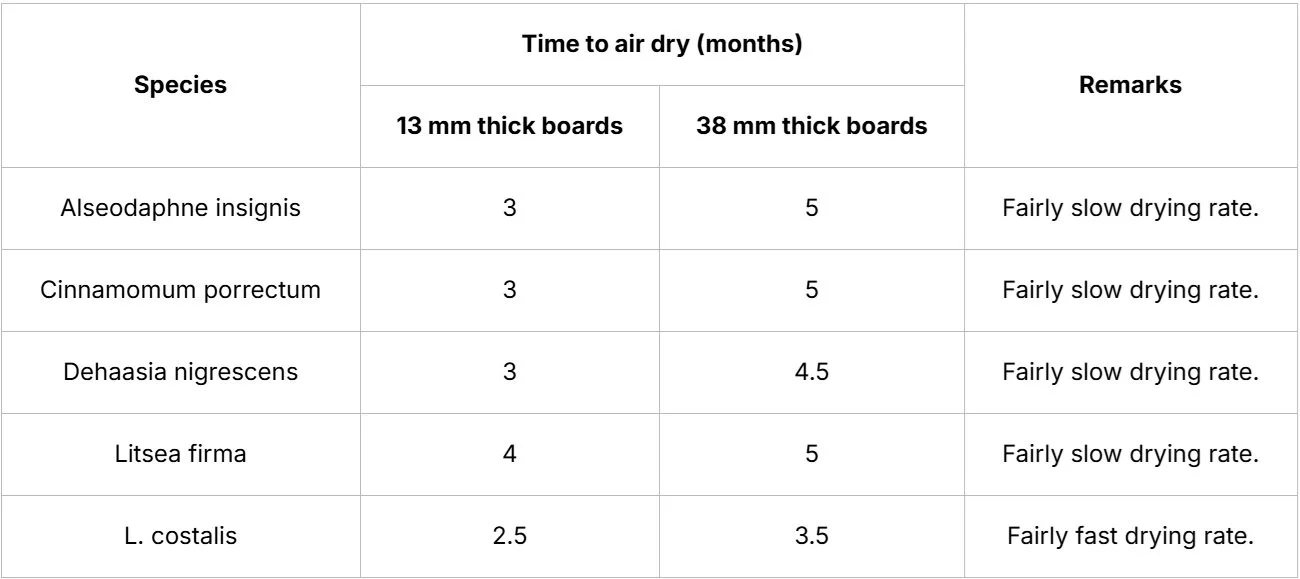
AIR DRYING
The seasoning characteristics of some species are summarised below:
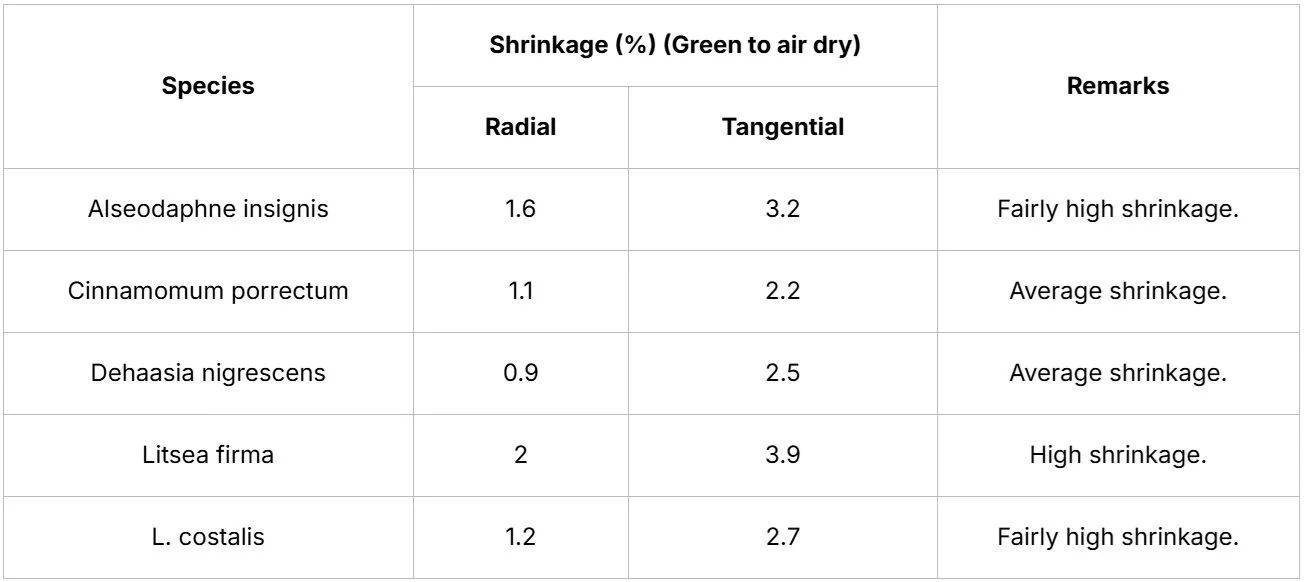
SHRINKAGE
The shrinkage of some species is summarised below:
USES
The timber is suitable for decorative works, interior finishing, panelling, mouldings, furniture, joinery, cabinet making, staircase (angle blocks, rough brackets, apron lining, newel and sprandrel framing), ship and boat building (general planking), ornamental items, pencil, tool handles (impact) and plywood, while the heavier species are suitable for medium construction under cover.
REFERENCES
Engku Abdul Rahman Chik. 1988b. Basic and Grade Stresses for Strength Groups of Malaysian Timbers. Malayan Forest Service Trade Leaflet No. 38. The Malaysian Timber Industry Board and Forest Research Institute Malaysia, Kuala Lumpur. 13 pp.
Menon, P. K. B. 1986. Uses of Some Malaysian Timbers. Revised by Lim, S. C. Timber Trade Leaflet No. 31. The Malaysian Timber Industry Board and Forest Research Institute Malaysia, Kuala Lumpur. 48 pp.
MS 544:Part 2:2001. Code of Practice For The Structural Use of Timber: Permissible Stress Design of Solid Timber.
Wong, T. M. 1982. A Dictionary of Malaysian Timbers. Revised by Lim, S. C. & Chung, R. C. K. Malayan Forest Records No. 30. Forest Research Institute Malaysia, Kuala Lumpur. 201 pp.
credited to : Malaysian Timber Council